
Written by Krystal Hilchey Muise & Monica van Schaik
We’ve noticed in our practice and social spaces that neurotypical and neurodivergent experiences are increasingly presented as a binary. We hear our clients compare themselves to what they believe “neurotypical people” can manage as if they are getting through day-to-day life with no struggle. These understandings reflect standards and expectations that are created within our society rather than the abilities of actual people. Neurotypical standards are rooted in societal expectations of productivity, focus, achievement, financial capital and colonialism. Very few people, no matter their neurotype, are actually capable of meeting these standards without significant effort and support.
Neurotypical Standards & Neuro-Conformity
Our automatic tendency to compare ourselves to neurotypical standards is one way that internalized ableism can show up. A term that captures this is neuro-conformity, the huge amount of pressure all people experience to uphold neurotypical standards. Neuro-conformity is also when we strive to do things in a way that reflects our perception of neurotypical standards. Neuro-conformity can really harm our view of ourselves and others. When neuro-conformity is getting the better of us, we may have thoughts such as: “If I were neurotypical I would already have my laundry done, have applied for more jobs, meal planned, been social and cleaned my house.” The pressure we feel to keep up with what society tells us neurotypical people can do, is a big way that this pressure to conform is present in how we navigate our daily lives. It is a red flag that neuro-conformity is creating a barrier to our wellbeing when we compare ourselves to unrealistic fictional people who uphold all or most neurotypical standards.

Neurodiversity
The neurodiversity movement has argued that all ways of thinking and processing the world are okay and normal. Through this framework we focus on accepting, including and accommodating differences rather than identifying norms and standards. When we knit, weave or crochet, we don’t blame the orange thread for not being green; we simply use the orange in the places where orange is best featured. Neurodiversity encourages us to think about what neurotype is best featured in specific situations, environments, roles and tasks. We don’t need to blame ourselves for being orange or green thread, or compare ourselves to another colour of thread, we can focus on looking for what allows our neurotype to be best used, supported and celebrated.

Neurotypical Standards are Colonial
Neurotypical standards have not always been so dominant and overpowering. Indigenous voices and ways of knowing remind us that ableist standards are enmeshed with colonialism. Dr. Grant Bruno, a Plains Cree Assistant Professor at the University of Alberta, researched Cree words for autism sharing, ê-mihkosit pihtos mânitonicihkan, which means given a different way of spiritual thinking. Dr. Nicole Ineese-Nash, Constance Lake First Nation Oji-Cree scholar and founder of Finding Our Power Together, emphasizes that disability and difference are opportunities to learn and strengthen the community as a whole. Leaving behind neurotypical standards is a way to decolonize how we think about the role of disability in our communities.
Neurodiversity Smorgasbord
Outside of this binary way of thinking, compassion for ourselves and others comes more easily. Everyone has their own sensory profile of sounds, sights, textures, tastes and smells. We all have differences in how we express emotions, feel empathy, communicate, remember, focus, listen and hold attention. Sonny Jane Wise created the neurodiversity smorgasbord (below) which can help us think about our unique experiences. Take a few minutes to consider how you identify with and experience each area in this smorgasbord. Knowing where your strengths and challenges are, where is your thread colour best featured? Where do you need support?
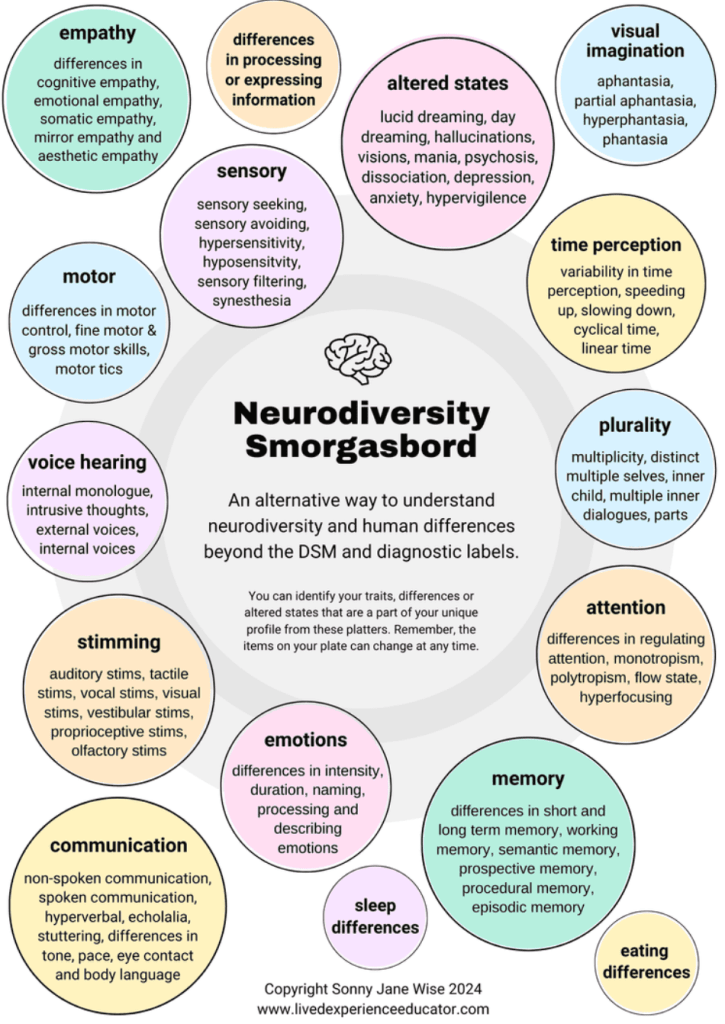
A decolonial neurodiversity focused approach helps us reach deeper and more helpful understandings of ourselves and others. We can start holding space for ourselves and everyone around us to show up differently. We can work together to decrease the pressure we all feel to conform to neurotypical standards. This supports us to decolonize the way we think about neurodiversity. So, next time you notice yourself thinking about what a neurotypical person could do, remind yourself that this person doesn’t exist, pull out the neurodiversity smorgasbord and remind yourself where your brain has strengths and challenges, and keep helping to weave a more accepting society for us all.
We’d love to hear about what you discover in this smorgasbord activity on our instagram page— @outoftheboxcounselling
References
Bruno, G., Chan, T. A., Zwaigenbaum, L., Coombs, E., The Indigenous Relations Circle & Nicholas, D. (2023). Indigenous autism in Canada: A scoping review. Journal of Autism and Developmental Disorders, June online.
Bruno, G. (N.D.). The Gift of Being Different. https://aidecanada.ca/resources/learn/asd-id-core-knowledge/the-gift-of-being-different. Retrieved April 8, 2025.
Finding Our Power Together. (2025). Finding Our Power Together. https://findingourpowertogether.com/. Retrieved April 8, 2025.
Ineese-Nash, N. (2020). Disability as a colonial construct: The missing discourse of culture in conceptualizations of disabled Indigenous children. Canadian Journal of Disability Studies, 9 (3), 28-51. https://cjds.uwaterloo.ca/index.php/cjds/article/view/645/898.
Kinross, L (2024). An Indigenous experience of Autism. https://research.hollandbloorview.ca/stories-news-events/BLOOM-Blog/indigenous-experience-autism. Retrieved February 4, 2025
Marble, John; Chabria, Khushboo; Jayaraman, Ranga (March 19, 2024). “Understanding Neurodiversity”. Neurodiversity For Dummies. John Wiley & Sons. p. 19. ISBN 978-1-394-21617-8. Archived from the original on February 4, 2025. Retrieved February 4, 2025.
Nordgren, A. (2006). The short instructional manifesto for relationship anarchy. The Anarchist Library.
Rivas Velarde, M. (2018). Indigenous Perspectives of Disability. Disability Studies Quarterly, 38 (4), Fall 2018.
Walker, Nick (2021). “Neurodiversity: Some Basic Terms & Definitions”. Neuroqueer heresies: notes on the neurodiversity paradigm, autistic empowerment, and postnormal possibilities. Fort Worth: Autonomous Press. ISBN 978-1-945955-27-3.
Woods. Sarah (Sept. 15, 2023). Autistic People and the Power of Nonconformity. Thinking Person’s Guide to Autism. ttps://thinkingautismguide.com/2023/09/autistic-people-and-the-power-of-positive-nonconformity.html. Retrieved April 8, 2025.
Wise, Sonny Jane. (2019). Resources. Lived Experience Educator. https://www.livedexperienceeducator.com/resources. Retrieved April 8, 2025.
Women and Children’s Health Research Institute. (2022). Women and Children’s Health Research Institute. https://www.wchri.org/ Retrieved April 8, 2025.
Plain Text Version of Neurodiversity Smorgasbord:
Graphic developed by @livedexperiencededucator
In the centre of the graphic is a grey circle that reads “Neurodiversity Smorgasbord; An alternative way to understand neurodiversity and human differences beyond the DSM and diagnostic labels.; You can identify your traits, differences or altered states that are a part of your unique profile from these platters. Remember, the items on your plate can change at any time.
Around the centered text are 16 circles in pastel green, orange, blue, purple, pink and yellow that read left to right:
empathy: differences in cognitive empathy, emotional empathy, somatic empathy, mirror empathy and aesthetic empathy
differences in processing or expressing information
altered states: lucid dreaming, day dreaming, hallucinations, visions, mania, psychosis, dissociation, depression, anxiety, hypervigilance
visual imagination: aphantasia, partial aphantasia, hyperphantasia, phantasia
motor: differences in motor control, fine motor & gross motor skills, motor tics
sensory: sensory seeking, sensory avoiding, hypersensitivity, hyposensitivity, sensory filtering, synesthesia
time perception: variability in time perception, speeding up, slowing down, cyclical time, linear time
voice hearing: internal monologue, intrusive thoughts, external voices, internal voices
plurality: multiplicity, distinct multiple selves, inner child, multiple inner dialogues, parts
stimming: auditory stims, tactile stims, vocal stims, visual stims, vestibular stims, proprioceptive stims, olfactory stims
attention: differences in regulating attention, monotropism, polytropism, flow state, hyperfocusing
communication: non-spoken communication, spoken communication, hyperverbal, echolalia, speller, stuttering, differences in tone, pace, eye contact and body language
emotions: differences in intensity, duration, naming, processing and describing emotions
memory: differences in short and long term memory, working memory, semantic memory, prospective memory, procedural memory, episodic memory
sleep differences
eating differences
Copyright Sonny Jane Wise 2024
www.livedexperienceeducator.com